
REPAIR – MAINTAIN – RESTORE
Commercial Roof Leak Repair in San Diego: Find the Source, Fix It Once
CSLB #1061541 · Commercial and multifamily properties only
On a commercial roof, water rarely comes through the ceiling where it gets in. It runs along the deck or down a wall and drips onto inventory, a lab bench or a ceiling grid well away from the actual failure. So the same leak can get patched three times and keep coming back.
Costa Roofing repairs commercial roof leaks for property managers, facility directors, HOA boards and building owners across San Diego County. We start inside the building and trace the water to where it actually enters. We repair it with materials the roof manufacturer will stand behind, and send you photos of what we found and what we did. If the roof needs more than a patch, we’ll tell you and show you why.
Call 858-339-1848 to have the leak looked at. Inspections are free anywhere in our San Diego County service area.
Leak Repair Starts With Leak Detection
Finding the leak is most of the work. The repair itself is often small: a resealed flashing, a rebuilt curb corner, a new seam. What makes a leak expensive is fixing the wrong thing, because every missed guess costs another storm of wet ceiling tiles and another tenant complaint.
This page covers active and recurring leaks. For storm damage, blistering or worn membrane that isn’t leaking yet, see commercial roof repair. If the whole roof is aging and you’re weighing a coating against replacement, see commercial roof restoration.
Why San Diego Commercial Roofs Leak When They Do
San Diego’s mild weather hides roof problems. A failure can sit on a roof for months before the right storm finds it.
The first storm after a long dry season. Most of the county’s rain falls between November and March. Over the summer, sealants shrink, marginal seams open slightly, and dust settles into drains and scuppers. None of it shows until the first real storm, so buildings that stayed dry last winter start leaking in the same week. Near the coast the failure is often corroded metal flashing; inland it’s more often heat-split seams and cracked mastic.
Santa Ana winds, then rain. Santa Ana winds usually blow in the fall, just ahead of the rainy season. The gusts pull at edge metal, loosen parapet coping and counterflashing, and blow debris into drains. The building doesn’t leak until the rain arrives weeks later, so nobody links the two.
When it isn’t the roof. Near the coast, moist air can condense on the underside of a steel deck overnight and drip in the morning even though the roof is intact. HVAC condensate lines overflow above ceilings. On tilt-up buildings, failed sealant between concrete wall panels lets wind-driven rain run down the inside of the wall, where it looks just like a roof leak. We check the interior first so you don’t pay for a roof repair that won’t solve the problem.
Where Leaks Start on San Diego Commercial Buildings
Tilt-up Industrial: Kearny Mesa, Miramar, Carlsbad, San Marcos
Warehouses along Miramar Road, through Kearny Mesa and in the Carlsbad and San Marcos business parks are mostly concrete tilt-up. Their low-slope roofs sit behind parapet walls on all sides. Water can only leave through scuppers and interior drains, so anything that slows drainage becomes a leak. We check parapet flashing and coping, scupper boxes, drains clogged over the dry season, low spots that hold water, and skylights.
Biotech and Lab Buildings: Sorrento Valley and Torrey Pines
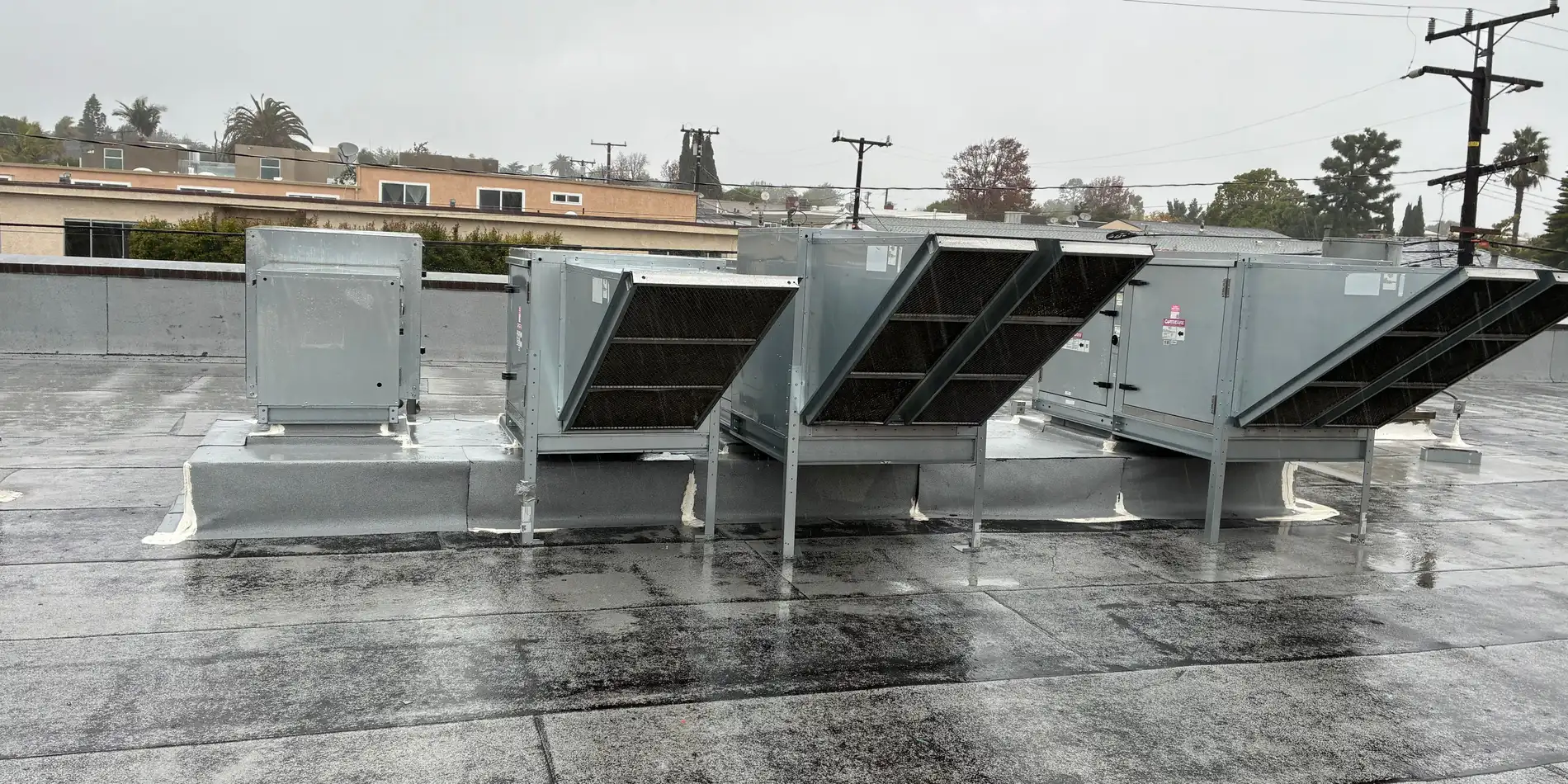
Life-science roofs are crowded: air handlers, exhaust fans, fume hood stacks, pipe racks and the supports that carry them. Every one of those penetrates the roof, and each tenant improvement adds more. Leaks usually trace to curbs, pitch pans and pipe penetrations flashed by a mechanical contractor rather than a roofer. A leak over a lab can stop work, so we plan the investigation around the tenant’s operations and access rules.
North County Office Parks, Retail Centers and HOAs
Office buildings in Carlsbad, Vista and along the SR-78 and I-15 corridors often have older built-up or modified bitumen roofs, sometimes coated before, with an HVAC unit over each suite. Those leak at aged seams and at curbs that weren’t re-flashed when a unit was replaced. Retail centers add sign penetrations, restaurant grease exhaust (grease breaks down many membranes) and a history of repairs by whoever each tenant hired. HOA and multifamily communities leak where flat sections meet walls, pitched roofs or walk decks.
The Usual Failure Points
- Flashings at walls, curbs and roof edges
- HVAC curbs and equipment supports, especially after a unit swap
- Drains and scuppers that are clogged, corroded or set higher than the roof around them
- Seams and laps in single-ply, modified bitumen and built-up roofs
- Penetrations: pipes, conduit, vents, exhaust stacks, sign supports
- Parapet walls: coping, counterflashing and the wall itself
- Ponding water that sits long enough to find any weak point beneath it
Leak Detection and Repair, Step by Step
Start Inside
We look at the stain pattern, which tiles are wet and what’s above the ceiling before we go up. We also ask your staff or tenants when it leaks. A leak that appears only in wind-driven rain points somewhere different from one that appears in every storm.
Map the Roof
We work outward from the area above the interior leak and upslope along the path water would take, checking every flashing, curb, seam, penetration and drain. We photograph all of it, including what looks fine.
Prove the Source
If the source isn’t obvious, we confirm it before you pay for a repair. Controlled water testing means running water over one detail at a time, starting low and working up, while someone watches inside. Where insulation may be wet, a core cut shows what’s under the membrane at that spot. On larger roofs, where water may have spread, we’ll tell you if a thermal scan would help and bring in a specialist we work with. Most leaks don’t need one.
Written Proposal With Photos
You get an itemized proposal with photos of the source and the cause. If a targeted repair will fix it, that’s what we propose. If insulation is wet across a large area, or the membrane is worn out well beyond the leak, we’ll lay out the options. That includes what happens if you only patch it for now. Coating over wet material traps the problem, so a wet roof points to replacement.
Repair, Retest, Document
We schedule work around your tenants, including off-hours when operations require it. Where practical, we water test the repair, then send before-and-after photos and a written summary you can forward to ownership, a board or an insurance adjuster.
Roofing Systems We Repair
- PVC, including Sika Sarnafil systems: leaks tend to come from flashing details and penetrations rather than welded seams.
- TPO: seam failures and flashing shrinkage as the membrane ages.
- Built-up roofing (BUR) and cap sheet: cracking and alligatoring under inland heat.
- Modified bitumen: lap seams and flashings.
- EPDM on older buildings: seam adhesive failure.
- Coated roofs (silicone and acrylic): coating breaches, or failure of the roof underneath.
Why San Diego Property Managers Call Costa for Leaks
Costa is a Sika Partner contractor for Sarnafil PVC and an approved contractor for SOPREMA, APOC and Western Colloid. Every job is documented with photos, for commercial and multifamily properties only, no houses. California CSLB License #1061541.
Stop Chasing the Same Leak Every Winter
Clogged drains, edge metal loosened by the Santa Anas and cracked sealant at a curb are cheap to fix in October and expensive to discover in January. A pre-season roof inspection, or scheduled visits under our ROOF PROTECT™ maintenance program, catches them while the roof is dry. Maintenance also builds the documented history many manufacturer warranties expect.
Commercial Roof Leak Repair Across San Diego County
We repair commercial roof leaks throughout San Diego County. That includes Kearny Mesa, Miramar, Mira Mesa, Sorrento Valley, Torrey Pines, La Jolla, Carmel Valley, Carlsbad and Oceanside. We also work in Vista, San Marcos, Escondido, Poway, Rancho Bernardo, Mission Valley, Encinitas, Chula Vista and El Cajon. See all San Diego service areas.
Frequently Asked Questions About Commercial Roof Leak Repair
How Much Does Commercial Roof Leak Repair Cost in San Diego?
That depends on what we find. Resealing one penetration or re-flashing one curb is a small job. If the leak has soaked the insulation under a section of roof, that section has to come out and be replaced, which costs far more. Roof access, equipment density and after-hours work also affect the price. Either way, you get an itemized proposal with photos before any repair work starts.
Will a Leak Repair Void Our Roof Warranty?
It can if the wrong contractor or material is used. Most manufacturer warranties require approved materials, often an authorized contractor, and sometimes notice to the manufacturer before work begins. Find the warranty document before anyone cuts into the roof. Costa is approved for Sika Sarnafil, SOPREMA, APOC and Western Colloid systems. If a different manufacturer warrants your roof, we’ll tell you what that warranty requires before we start.
Can You Work on an Occupied Building?
Yes. Almost every commercial leak repair is done on an occupied building. We coordinate roof access, noise, adhesive odors and any interior work with your team and tenants. For lab and medical tenants, we plan around air intakes and access rules.
How Quickly Can You Respond to an Active Leak?
Call as soon as you see water. We’ll help you protect the space while we schedule the visit. In heavy rain, the first visit is usually a temporary repair to stop the water. Most permanent repairs need a dry surface, so we come back once the roof dries, and we’ll tell you which kind of repair you’re getting.
Why Does Our Roof Only Leak in Some Storms?
Different storms hit the roof in different ways. A leak that appears only in wind-driven rain usually points to a parapet, coping or wall flashing on the windward side. A leak that appears only in long, heavy rain often means a drain or scupper can’t keep up, or ponding water is rising to a weak seam. Telling us when your roof leaks is one of the most useful things you can do.
It’s Been Patched Before and Still Leaks. Why?
Usually the patch went where the water showed up rather than where it got in, or the patch material didn’t match the roof. For example, asphalt mastic over a PVC or TPO seam can look like a fix and still fail within a season. We trace the source first and use materials matched to the membrane.
Request a Free Commercial Roof Leak Inspection
Tell us where the water is showing up and what kind of building it is. We’ll find the source, show you what we found, and give you a straight recommendation. No pressure to do more than the roof needs.
Call 858-339-1848 or request a free inspection online.