
REPAIR – MAINTAIN – RESTORE
Commercial Roof Repair in San Diego: Fix the Damage, Keep the Warranty
CSLB #1061541 · Commercial and multifamily properties only
Most commercial roof damage is found before it leaks. An HVAC technician spots a split seam beside a unit, a Santa Ana wind leaves edge metal flapping, or an inspection report flags blisters and rusted fasteners. Someone then has to decide what gets fixed, how, and whether the repair will stand up if there’s ever a warranty claim.
Costa Roofing repairs commercial and flat roofs for property managers, facility directors, HOA boards and asset managers across San Diego County. We repair seams, flashings, membrane, edge metal, drains and penetrations with materials that match the roof system. We photograph the damage and the finished repair, and you get an itemized proposal before any work starts. If the damage says the roof is past repairing, we’ll tell you that too.
Call 858-339-1848 to request a free roof inspection. Inspections are free anywhere in our San Diego County service area.
What Commercial Roof Repair Covers
Repair means fixing known, visible damage on a roof that still has years left in it, ideally before it leaks.
- Water already coming in from an unknown source: commercial roof leak repair.
- The whole surface aging over dry layers: commercial roof restoration.
- Scheduled upkeep: our ROOF PROTECT™ maintenance program. A written condition report with no repair attached: ROOF INSPECT.
Commercial Roof Damage We Repair in San Diego
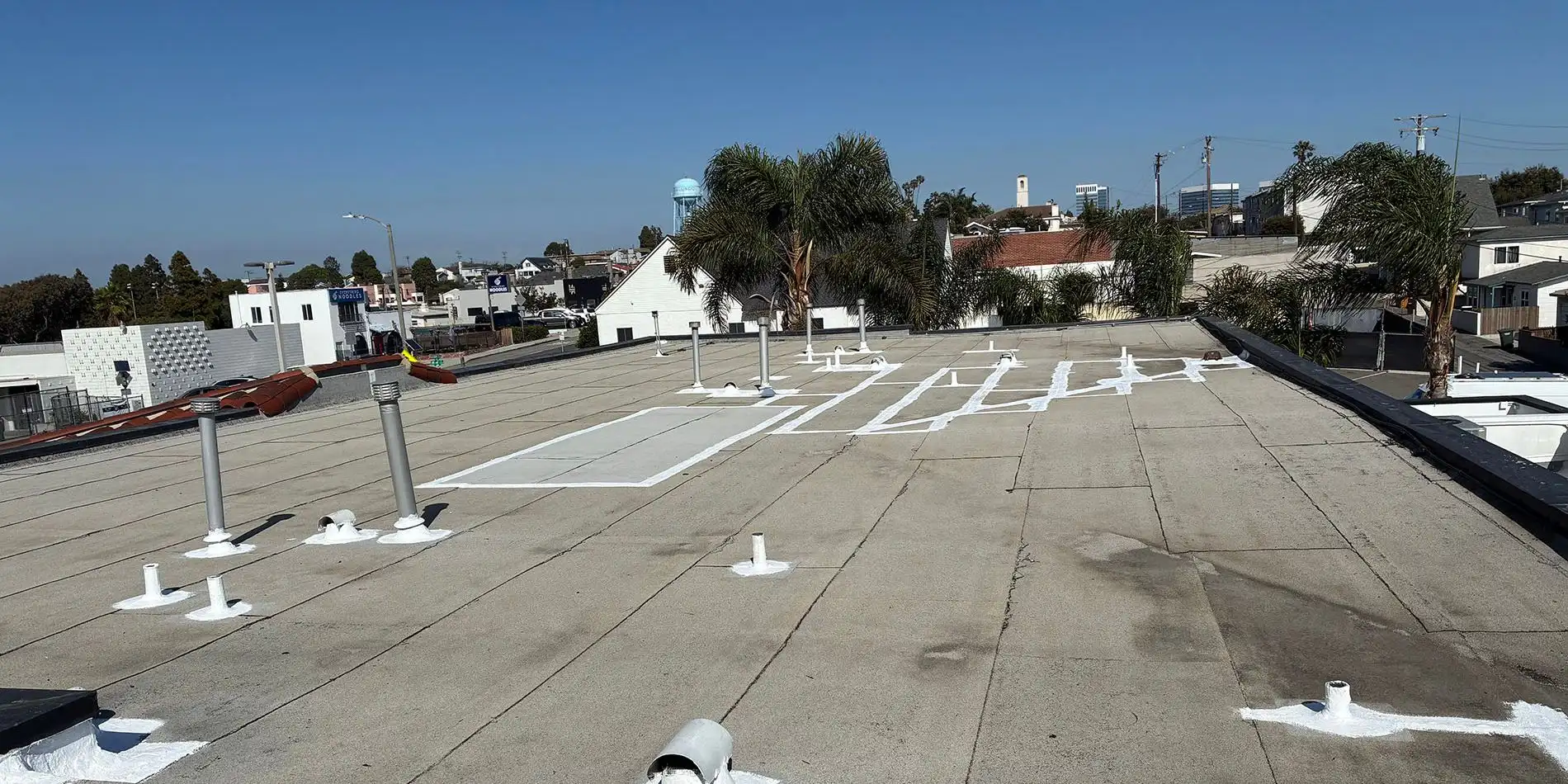
Split and open seams. Laps on single-ply, modified bitumen and built-up roofs pull apart under daily heat cycling. It’s worst where the roof went down in cool weather or the seam was never fully welded or bonded. We cut out the failed section and rebuild it in the same material.
Failed flashing and counterflashing. Base flashing at parapets, walls and curbs shrinks, cracks and pulls away from the wall over time. The metal counterflashing above it loosens or corrodes.
Punctures and tears in the membrane. Dropped tools, screws left behind by other trades, ladder feet, equipment dragged across the roof during an HVAC swap. A single-ply membrane is tough but thin.
Blisters and ridges. Blisters form where trapped moisture or air separates membrane layers. Ridges form along insulation board joints. Small, stable blisters can often be left and watched. Blisters that are growing, cracking or sitting in foot-traffic paths get cut, dried and patched. Widespread blistering can mean moisture in the roof, which core cuts check before any repair.
Cracked and alligatored cap sheet and BUR. When the granules or asphalt surface of a cap sheet or built-up roof wear away, the surface dries out, crazes and cracks into a pattern like alligator skin. Localized areas can be cut out and patched. Widespread alligatoring is usually a restoration conversation.
Penetrations, pitch pans and mastic. Pipes, conduit, gas lines, exhaust stacks and sign supports are sealed with pitch pans, boots and mastic that dry out and pull away. We replace failed pitch pans and boots rather than piling new mastic on old.
Edge metal, coping and gutters. Loose edge metal lets wind under the membrane, and displaced coping exposes the top of a parapet wall. We re-secure or replace the metal and re-flash where it meets the roof.
Drains, scuppers and ponding damage. Clogged or corroded drains, crushed strainers and scuppers set too high leave water standing on the roof. Standing water wears membrane and coatings faster. We repair the drain assembly, and if a low spot keeps holding water we’ll tell you what fixing the slope would take.
Rusted metal panels and fasteners. On metal roofs and metal details, rust starts at fasteners, laps and cut edges. We replace fasteners, treat and seal rusted areas, and replace panels that have rusted through.
Damaged coatings, skylights and old patches. Coatings wear thin or peel, skylight curbs crack, and earlier repairs made with the wrong material, such as asphalt mastic over a PVC or TPO seam, come loose. We remove failed repairs and redo them properly.
What San Diego Does to a Commercial Roof
- Salt air on the coast. In Oceanside, Carlsbad, Del Mar, La Jolla and Sorrento Valley, fasteners, edge metal, coping, drain bodies and metal panels corrode before the membrane wears out. Much coastal repair is metal work.
- Heat inland. In Escondido, San Marcos, Poway, Ramona and East County, daily heat cycling opens seams, splits flashing corners, cracks mastic and dries out asphalt surfaces.
- Rooftop trade traffic. Lab roofs in Sorrento Valley and Torrey Pines, and tilt-ups in Kearny Mesa, Miramar, Carlsbad and San Marcos, collect equipment, solar and new penetrations. Much of the damage is mechanical: punctures, cuts and penetrations nobody flashed properly.
Storm and Wind Damage Repair
After a winter storm or Santa Ana wind, damage often shows on the roof even when the building stayed dry. Wind works under loose edge metal and perimeter membrane until it tears, leaving lifted edge metal, displaced coping and torn corners. Drains block with palm fronds and trash.
We secure what’s loose first so the next storm doesn’t make it worse, then photograph every item and give you an itemized repair proposal. That record is what ownership and an insurance adjuster will want to see; the claim itself stays between you and your insurer. If water is already inside the building, the job starts with commercial roof leak repair instead.
Repairs Made With the Manufacturer’s Materials
Most commercial roof warranties are backed by the membrane or coating manufacturer, and many stay valid only if repairs use compatible materials and approved details. Some also require an authorized contractor or notice before repairs. The wrong product gives the manufacturer a reason to deny a later claim.
So we repair each system in its own material. PVC is repaired with PVC, heat-welded. TPO gets TPO. Modified bitumen and cap sheet get compatible modified bitumen. Coated roofs are repaired with a product the coating will bond to: only silicone sticks to silicone, while acrylic coatings have their own compatible products.
Costa is a Sika Partner contractor for Sarnafil PVC and an approved contractor for SOPREMA, APOC and Western Colloid. If a different manufacturer warrants your roof, send us the warranty and we’ll tell you what it requires before work starts.
What we don’t do is mastic-and-hope: roof cement troweled over a split seam or lifted flashing. It looks fixed from a distance, tends not to last, and can compromise the warranty.
How a Commercial Roof Repair Works
Free Inspection
We start with the damage you know about, then check the rest of the roof for related problems. That means other seams in the same run, flashings of the same age and curbs the same contractor worked on. Everything is photographed.
Written Proposal With Photos
You get an itemized proposal that shows each repair with a photo, the material we’ll use and the cost. Items are ranked: what needs doing now and what can wait. If the damage suggests an active leak, the proposal says so.
Repair, Scheduled Around the Building
We schedule work around tenants and building operations, including off-hours where needed. On lab, medical and restaurant buildings we plan around air intakes, since some adhesives and primers have an odor.
Documented Completion
You get before-and-after photos of each repair and a written summary of the work and materials, ready to forward to ownership, an HOA board, an adjuster or the manufacturer.
Roofing Systems We Repair
- PVC, including Sika Sarnafil systems: heat-welded patches, re-welded seams and rebuilt flashings.
- TPO: seam and flashing repair in TPO, including older sheets that need cleaning before a new weld will take.
- Built-up roofing (BUR) and cap sheet: cut-out and patch repairs, blister repair and re-flashing.
- Modified bitumen: lap repairs, torn sheet and flashing replacement.
- EPDM: seam and patch repairs on older buildings.
- Metal: fasteners, panel laps, rusted panels, edge metal and flashings.
- Silicone- and acrylic-coated roofs: coating repairs and repair of the roof underneath.
We repair other low-slope systems too. Tell us what’s on your roof.
When Repairs Stop Making Sense
Repairs make sense when damage is localized and the rest of the roof has years left in it. They stop making sense when the damage is the roof wearing out everywhere at once. Signs of that:
- The same kind of failure keeps appearing across the whole roof, such as seams opening run after run or cap sheet alligatored across the field.
- The repair budget is growing year over year without the list getting shorter.
- Water has reached the insulation or deck over a large area.
- The membrane has come loose from the insulation beneath it.
At that point we’ll show you the photos and say so. If the layers beneath are dry, a coating system may cost far less than replacement: see commercial roof restoration. If they’re wet or detached, the roof needs replacing, and we re-roof in Sika Sarnafil PVC, by tear-off or recover depending on what’s underneath.
Commercial Buildings We Repair in San Diego
- Industrial and warehouse: tilt-up and light-industrial buildings in Kearny Mesa, Miramar, Mira Mesa, Carlsbad, San Marcos, Vista and Poway.
- Biotech, lab and life-science: equipment-heavy roofs in Sorrento Valley and Torrey Pines.
- Office and business parks: North County buildings along the SR-78 and I-15 corridors.
- Retail centers: sign supports, restaurant exhaust and years of patches by different contractors.
- HOA and multifamily: flat sections over units, carports and walkways.
- Medical office, schools and institutional buildings.
Why San Diego Property Managers Choose Costa for Repairs
Matched, manufacturer-approved materials on every system, photos from proposal to completion, and commercial and multifamily roofs only, no houses. California CSLB License #1061541.
Commercial Roof Repair Across San Diego County
We repair commercial roofs throughout San Diego County. That includes Sorrento Valley, Torrey Pines, La Jolla, Carmel Valley, Kearny Mesa, Miramar, Mira Mesa, Carlsbad and Oceanside. We also work in Vista, San Marcos, Escondido, Poway, Rancho Bernardo, Mission Valley, Encinitas, Chula Vista and El Cajon. See all San Diego service areas.
Frequently Asked Questions About Commercial Roof Repair
How Much Does Commercial Roof Repair Cost in San Diego?
It depends on the system, the extent of the damage, roof access and how much equipment is in the way. Re-flashing one curb is small; rebuilding a wind-damaged roof edge is not. You see the cost of each item, with photos, before approving anything.
Can You Repair Damage Caused by Another Contractor?
Yes. HVAC, electrical, solar and sign contractors cause a lot of commercial roof damage. We photograph and describe it in the proposal, which gives you what you need to take it up with the contractor or tenant responsible.
Does a Roof Repair Trigger Title 24 Cool-Roof Requirements?
Small, targeted repairs generally don’t. When the work becomes replacing, re-covering or recoating a large share of a low-slope commercial roof, California’s Title 24 cool-roof rules can apply. We’ll flag it in the proposal if your scope gets there. More on cool roofs: commercial roof restoration.
Should We Repair a Roof We Plan to Replace in a Few Years?
Usually yes, with a limited scope. Keeping water out and edge metal secure protects the insulation and deck, and dry insulation is what keeps cheaper options like restoration open. We’ll propose the minimum that protects the building and point out anything that would be wasted money on a roof that’s coming off.
Request a Free Commercial Roof Repair Inspection
Tell us what’s been found: a report, a technician’s photos or storm damage. We’ll inspect the roof, photograph what we find and give you an itemized repair proposal. No pressure to do more than the roof needs.
Call 858-339-1848 or request a free inspection online.